
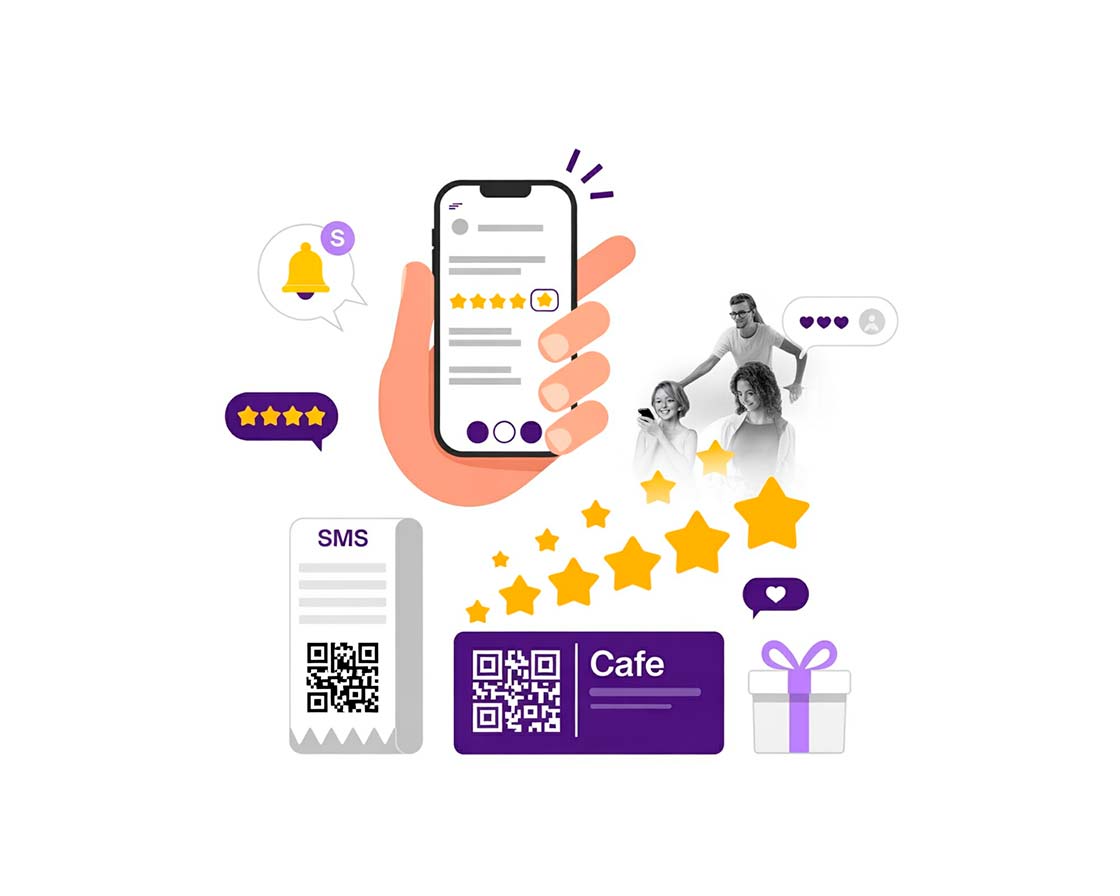
The core imbalance in review management: happy customers stay quiet, unhappy ones write essays. This is basic psychology, and there is no point fighting it. If you do nothing, your listing will naturally drift toward the negative: for every 27 positive reviews that never get written, there will be one negative review that does (according to a Harvard study on consumer behavior).
The fix for this imbalance is collecting reviews from real customers in a systematic way. No fake reviews and no gray-area tricks: these are legal techniques that raise the share of happy customers who leave a review from the natural 2-3% to 12-18%. This article covers 12 proven methods with real performance numbers and step-by-step instructions.
Why waiting for "organic" reviews is a bad strategy
When a customer gets a service they are happy with, their brain treats it as "normal". They paid, they got what they paid for. No debt, no urge to tell the world anything. They leave, forget and move on. From an evolutionary point of view this makes sense: warning the tribe about danger (a bad experience) matters more than praising good food (a normal experience).
The practical takeaway: betting that "happy customers will write reviews on their own" is betting against biology. You will not win that bet. Businesses that actively collect reviews build 4-6 times more reputation capital than those that don't, with the same service quality and the same customer flow.
Method 1. A QR code on the receipt or business card
Conversion: 6-10% when done right. This is the most basic method and also one of the most effective. You print a QR code that leads straight to the review form on the platform you need (Yandex, 2GIS, Google), so the customer doesn't have to search for your business. One tap, and they are already on the review page.
Where to put it: on receipts after payment, on business cards, on food delivery packaging, on service certificates, in gift bags. The caption under the QR code should be short and human: "We'd be grateful for your review, it helps us get better" instead of the stiff "Please leave a review on our service".
An important technical detail: the link must go directly to the review form, not to the listing itself. Many businesses link to the listing, but then the customer lands on a page with dozens of other reviews, starts reading them, gets distracted and never writes their own. A direct link to the form gives 2-3 times higher conversion.
Method 2. An SMS 2-3 days after the visit
Conversion: 8-15% depending on the niche. Timing is the key factor. Right after the visit the customer hasn't processed the experience yet, and a week later they have already forgotten it. A window of 2-3 days after the visit is the sweet spot: the impressions are still fresh but have settled, and the person can judge the experience as a whole.
SMS text: "Hello, [name]! Thank you for choosing [business name]. We'd be grateful for a short review of your visit: [short link]. Tatiana, owner." A signature from a real person (with a name) raises conversion by 30-40% compared to a faceless "The management".
A technical point: use link shorteners (bit.ly, vk.cc) or your own domain. Long Yandex Maps links look suspicious, and customers often don't open them. A good link is short and clear: yourbusiness.ru/review.
Method 3. A script for the front desk at checkout
Conversion: 4-8% on the first mention, up to 12% if staff do it consistently. A personal request from a person always works better than an impersonal one (via QR or SMS). But it requires staff training and oversight.
A script that works: "If you enjoyed everything, it would really help us if you left a review. There's a QR code on your receipt, it takes literally a minute, and for us it's the most valuable feedback." The wording matters: "please leave a review" is polite but impersonal, while "it would help us" is a personal request, and that works better.
What not to do: don't ask for a "5-star review" (this breaks the rules of most platforms and can lead to penalties), don't push, and don't offer a reward in exchange for a specific rating. The request should be neutral in content.
Method 4. An incentive loyalty program
Conversion: 15-25%, the highest of all the methods. The idea: the customer gets a discount or bonus on their next visit for leaving a review. This is legal as long as you follow one rule: the reward is given for leaving a review, not for a specific rating.
How to word it: "Leave a review on Yandex Maps and get 10% off your next visit". Never "leave a 5-star review": that breaks the rules, and Yandex may flag such reviews. The correct wording keeps the program legal and acceptable to the algorithms.
Bonus size: 5-10% of the average bill is enough. Less doesn't motivate, and more makes the customer feel that "they want reviews a bit too badly", which lowers trust.
Method 5. A call from a manager asking for feedback
Conversion: 18-30%, the highest, but expensive in terms of time. This method suits businesses with a high average bill (dentistry, premium cosmetology, legal services, B2B). A manager calls 3-5 days after the service, asks how it went, and at the end of the conversation, if the customer is happy, asks them to leave a review.
Why it works: a personal call makes the customer feel that "the business cares". During the conversation you can find out how the customer really feels and "filter out" the unhappy ones by not asking them for a public review. (That doesn't mean ignoring their complaints. Quite the opposite: these customers deserve the most careful attention, just without the public part.)
Cost of the method: one manager can make 30-50 calls a day. With an average bill of 5,000+ rubles the economics work out well: each review costs 100-200 rubles in labor and brings a long-term reputation effect.
Method 6. A post-purchase email sequence
Conversion: 4-8%, lower than SMS, but it works for online businesses. Suitable for online stores, online services and education platforms. The email goes out 5-10 days after delivery or use, asking for a review.
Email structure: a personal greeting, thanks for the purchase, a request for a review with a direct link, and a clear note on where exactly the review is needed. No long texts or marketing inserts: keep it short and to the point.
Important: the subject line is critical. "Tell us about your experience" works 2-3 times better than "Leave a review". The first sounds like a request for help, the second like a demand.
Method 7. A widget on your website or in your app after purchase
Conversion: 6-12% of those who completed the action. A pop-up or embedded block saying "Enjoyed your purchase? Tell us about it" appears a set time after the order is placed or the service is completed. It works best when the widget is unobtrusive and shows up only once.
Technical requirements: an option to skip (a close button in the corner), no repeat display for the same user, and a link to the review form, not to the listing. A widget that pops up every time and covers half the screen backfires: users start to get annoyed with the brand.
Method 8. A contest or giveaway among reviewers
Conversion: 12-20% during the active phase of the contest. Everyone who leaves a review within a set period enters a prize draw (a gift certificate, a service, a product). The method brings a strong one-time surge of reviews, but it has limits.
What matters: the draw must be for leaving a review, not for a specific rating, otherwise it breaks the rules. The prize should be substantial (from 5,000 rubles), since a small prize doesn't motivate anyone. The terms should be simple and transparent. The winner must be real and publicly announced (so future participants trust you).
The risk: a sharp spike in reviews over a short period may look like manipulation to the algorithm. The fix is to run the contest for 3-4 weeks instead of 3-4 days, and to make sure reviews come from different accounts and different IP addresses (you can't control this directly, but with an honest contest and real participants you don't need to).
Method 9. A paper survey that leads online
Conversion: 8-14% for offline businesses. The customer gets a short paper survey (3-5 questions about the visit). At the end there is a call to action: "If you enjoyed your visit, leave a review on Yandex using this QR code". The method works because the survey has already put the customer in "feedback mode", and a public review becomes a natural next step.
Where to use it: restaurants, beauty salons, medical clinics, fitness centers, anywhere there is a pause (waiting, getting ready to leave) when the customer can fill out a short form. Surveys are also a source of internal feedback, which is valuable in itself.
Method 10. Asking on social media
Conversion: 2-6% of followers. Regular posts (1-2 times a month) on Instagram/VK/Telegram asking followers to leave a review. Conversion is low compared to the other methods, but it gives a steady flow of reviews from a loyal audience.
Post format: personal, not corporate. "Friends, we put a lot into quality and service, and it really matters to us that new customers can find out about it. If you've been to see us and liked it, we'd be very grateful for a review. It takes a minute and means a lot to us. Link in bio." An emotional tone is 2-3 times more effective than a dry request.
Method 11. Partnering with micro-bloggers
Conversion: indirect, through a bigger customer base. Micro-bloggers (1,000-10,000 followers) try your service and write an honest review on their own channel and on a maps platform. This brings in new customers and sends a reputation signal at the same time.
What matters: the blogger should be from your region and work in a related niche (beauty bloggers for a beauty salon, food bloggers for a restaurant). The review must be honest: attempts to buy a purely positive review get spotted by both followers and algorithms.
Method 12. Automation with review collection services
Conversion: 10-18% when set up correctly. Services like Revvy, Mneniya.pro and Repometr automate messages via WhatsApp/SMS/email with direct review links. They integrate with your CRM or booking system and launch sequences automatically after a visit.
The upside: consistency and scale. Set it up once and it runs on its own, with no staff involvement. It suits businesses with 200+ customers a month, where sending SMS by hand becomes a chore.
The downside: setup takes 1-2 weeks, requires integration with your systems and costs from 5,000 rubles a month. For small businesses this is overkill, while medium and large ones recoup it in 1-2 months.
What NOT to do when collecting reviews
Asking for a specific rating
Asking customers to "leave a 5-star review" breaks the rules of every maps platform. Yandex and 2GIS algorithms catch these requests (they often show up in screenshots of SMS campaigns that customers themselves post on forums) and apply penalties. Ask for a review and let the customer choose the rating.
Screening customers before asking
Some businesses use this scheme: "ask the customer if they liked it; if yes, send them to leave a review; if no, send them to an internal feedback form". It is technically legal, but ethically a gray area: you are artificially keeping negative feedback out of public view. If the scheme becomes public (and that happens), the damage to your reputation is huge.
Paying for reviews
Paying customers directly for a review breaks the rules of every platform and comes close to buying reviews. A discount or bonus on the next service is acceptable, because it encourages a return visit and isn't a direct payment. Money sent to a card in exchange for a review is not.
Summary table: which method to choose
For a business with up to 50 customers a month: a QR code plus a personal request from the front desk. Simple methods that need no investment.
For a business with 50-200 customers a month: QR + SMS sequence + front desk script + incentive loyalty program. This combination gives 25-35% conversion.
For a business with 200+ customers a month: an automated collection service (Revvy, Mneniya) + SMS sequence + front desk script + quarterly contests. A complete system with minimal staff involvement.
For the premium segment (average bill of 10,000+): a personal call from a manager + a personal email request + contests among regular customers. High conversion from each customer matters more than total volume.
The bottom line
Collecting reviews from real customers is not a "someday" project. It is daily operational work, just like cleaning the floor or answering the phone. Combined, the 12 methods above turn 15-25% of your customers into public reviewers. For a business with 200 customers a month, that's 30-50 new reviews every month: enough for steady growth in rating and search position without any managed review placement.
If you don't have the time or resources to build a collection system from scratch, or your customer flow is still small and organic reviews aren't enough to grow, a hybrid model makes sense: systematic collection from real customers plus safe managed placement to speed things up. The key is to avoid extremes, whether it's "organic only, speed doesn't matter" or "fake reviews only, risks don't matter".