
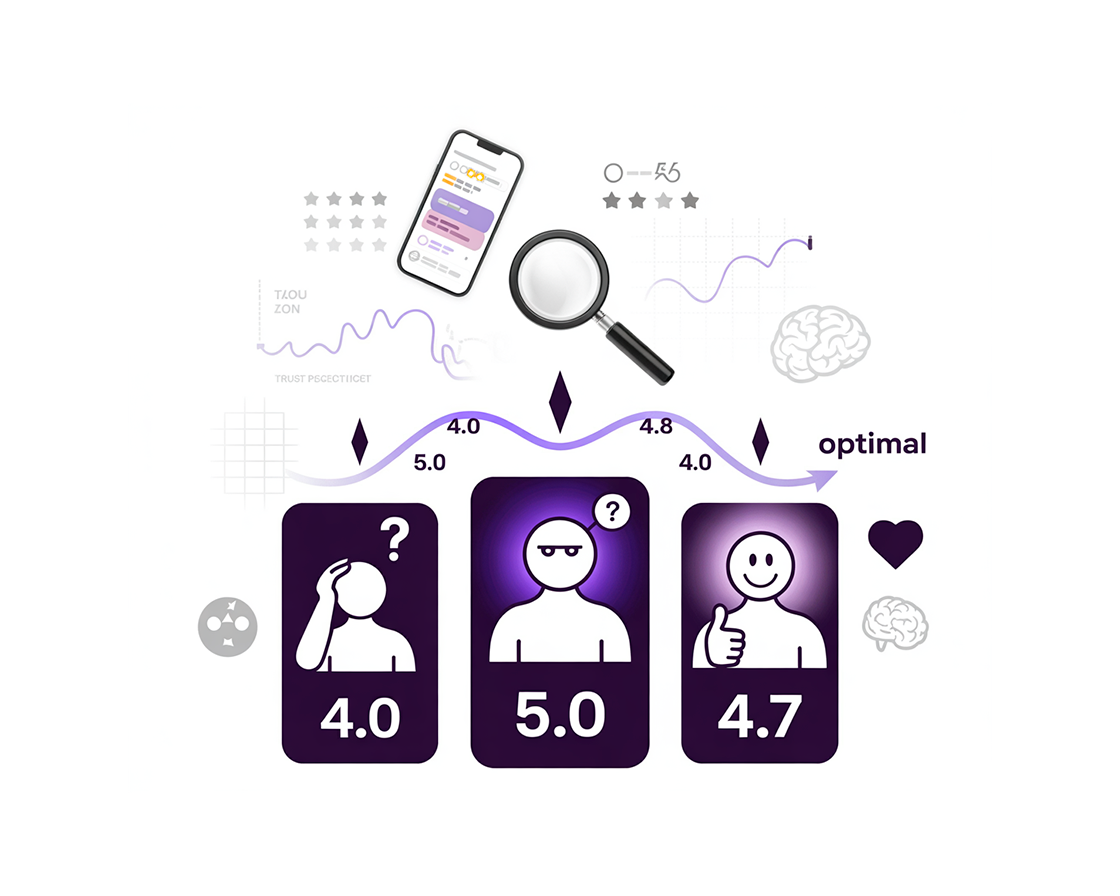
Most business owners are sure of one thing: the higher the rating, the more customers. The logic seems obvious: 5 stars beat 4 stars, how could it be otherwise? But a decade of consumer behavior research shows that this intuition only holds up to a certain point. Past that point, the rating starts working against the business: a listing with a perfect 5.0 turns fewer views into real inquiries than a listing with 4.7.
This is known as the "rating paradox", and it changes the whole approach to reputation management. In this article we'll look at why a high rating can hurt, where the "sweet spot" actually is, how to build the right spread of ratings, and why an "honest" rating with a small share of 4s and 3s sells better than a "perfect" one made entirely of 5s.
The Northwestern study: numbers that change everything
In 2014, the Spiegel Research Center at Northwestern University published a study that is still the main empirical source on this topic. The researchers analyzed data from more than 2 million purchases on major e-commerce platforms and compared product ratings with purchase conversion.
The key finding: the best rating range for conversion is 4.0-4.7. Within this range, conversion grew as the rating went up. But after 4.7 the curve started to turn: listings rated 4.8-5.0 converted worse than listings rated 4.5-4.7. The gap between 4.7 and 5.0 wasn't dramatic (around 5-8% in conversion), but it was statistically significant and consistent across categories.
Similar studies in the following years confirmed this effect in different markets and niches, for both services and products. The rating paradox is a stable pattern in consumer behavior, not a quirk of a single dataset.
Why people distrust a perfect rating
Why does someone who sees a 5.0 rating start to doubt it, often without realizing it? Several factors are at play.
Factor 1. Cognitive dissonance
Today's internet users know there's no such thing as a perfect business. Every cafe, salon or shop has slipped up at some point: delayed an order, served a customer poorly, dealt with a picky visitor. If there isn't a single 4 or 3 among 200 reviews, that goes against real-life experience, and the brain flags it: "something's off here."
Factor 2. Fake review fatigue
Over the past 10 years the market has been flooded with fake reviews. Review exchanges, fake accounts, freelancers who write a review for 50 rubles: the average user runs into all of this regularly and has learned to spot the signs. A flawless profile with nothing but 5-star reviews is the biggest sign of all.
Factor 3. Looking for the "truth"
When people make a buying decision (especially an expensive one: a medical service, a renovation, a premium product), they deliberately look for negative reviews to find the hidden catches. If there's no negativity at all, they don't relax, they get suspicious. Paradoxically, 1-2 four-star reviews with constructive criticism ("had to wait a while", "parking is a bit tight") reassure a customer more than 100 five-star ones.
Factor 4. Social proof that the business is "real"
People want a business to look "real". Small flaws make the story of a business believable, the same way any good story needs a few weak spots for people to buy into it. A flawless rating takes that credibility away.
Rating zones: what each one means
The "red alert" zone (3.0-3.9)
The business loses around 60-70% of potential customers at the moment they look at the listing. They see the rating and decide "no, I'm not going there" before they even open the reviews. This zone calls for urgent reputation work. Neither organic collection nor "we'll get there eventually" will do the job: you need systematic review collection, controlled placement and active work with negative reviews, all at the same time.
The dead zone (4.0-4.4)
The worst zone of all. Too average to trust, yet too decent to write off as poor quality. Customers hesitate the longest here and, in most cases, pick a competitor that's easier to read: either clearly good (4.6+) or clearly cheap. Businesses in this zone lose more customers than businesses rated 3.9, because those at least have a clear "budget" audience.
Sweet spot (4.5-4.8)
The ideal zone for most businesses. The rating is high (which means good quality), but not so high that it raises suspicion. In this zone people see the listing and think "looks like a decent place, let's go". Conversion peaks here.
The suspicion zone (4.9-5.0)
Paradoxically, a 4.9-5.0 rating on a large number of reviews (50+) often triggers distrust at a subconscious level. Conversion is usually 5-10% lower than at 4.7-4.8, all else being equal. The exception is a newly opened business with 5-10 reviews and a 5.0 rating: that's normal, because the volume hasn't yet grown to a suspicious level.
The optimal rating distribution
An "honest" rating profile isn't a matter of luck. It's a specific distribution that maximizes customer trust. For most local businesses, the optimum looks like this:
- 75-80% five-star reviews (a large base of satisfied customers)
- 15-18% four-star reviews (normal variation)
- 3-5% three-star reviews (some constructive criticism you can answer in public to show how you work)
- 0-1% two- or one-star reviews (rare conflicts that have professional replies)
This gives an average rating of about 4.7, right in the sweet spot. With this distribution every rating category looks believable: there aren't "suspiciously many" 5s, and the number of 4s and 3s looks natural.
How to use 4s and 3s to your advantage
Four- and three-star reviews aren't defects. They're an asset: if you reply to them well, they work for you harder than some 5-star reviews do.
The "detailed reply to a 3-star review" strategy
When a customer leaves a 3-star review with constructive criticism (for example, "everything was fine, but we waited a long time for the technician"), it's the perfect chance to show how the business handles feedback. A detailed reply with specific steps ("we looked into it, and starting Wednesday we're sending SMS alerts about delays") builds more trust than 10 replies to 5-star reviews. A future customer reads that reply and sees: "this is a real business that listens to criticism."
The "counterpoint" strategy
If a 4-star review contains mild criticism of a specific detail ("prices are a bit higher than expected"), your reply can explain the reasoning in detail: "Our prices really are above the local average: we use grade A materials and only work with specialists who have at least 5 years of experience in the premium segment." That's positioning rather than an excuse, and future customers read it.
Traps business owners fall into
Trap 1. Chasing 5.0 at any cost
The most common mistake. The owner sees a competitor at 4.6 and thinks "I'll get 4.9 and beat them." They end up ordering a flood of identical 5-star reviews, reach 4.95, and wonder why conversion isn't growing to match. The target is "in the sweet spot", not "higher than everyone".
Trap 2. Filtering out unhappy customers
Some businesses use this scheme: when collecting reviews, they first ask the customer "how did everything go?". If the answer is "great", the customer gets the review form; if not, an internal feedback form. Technically it's legal, but it creates a "too clean" profile of nothing but 5s and lowers trust, which is the opposite of what was intended.
Trap 3. Deleting every negative review
Trying to remove every negative review (even a constructive one) leaves you with a sterile profile that nobody believes. You're better off with 2-3 four-star reviews containing criticism you've answered in detail than with a flawless profile of 200 five-star reviews.
Trap 4. Cookie-cutter 5s from loyal customers
If you actively ask regular customers for reviews and they all write "everything's great, highly recommend", you end up with a "template" profile. The Yandex algorithm flags repetitive texts like these, and users trust them less too. Encourage detailed reviews with specifics, even when the rating is 5 stars.
What to do depending on where you start
Starting point: 5.0 with 5-15 reviews
Don't worry, this is normal for a new business. As you grow to 50+ reviews, natural 4s and the odd 3 will appear, and the rating will settle into the 4.7-4.8 sweet spot on its own. You don't need to do anything special, just keep doing good work.
Starting point: 5.0 with 80+ reviews
This already looks suspicious. Most likely either fake reviews with identical 5s were used, or unhappy customers were filtered out. Strategy: consistently encourage detailed reviews from real customers (via QR codes + SMS) and don't stand in the way of 4s and 3s. This will gradually bring the rating down into the sweet spot and increase trust.
Starting point: 4.6-4.8 at any volume
The ideal position. Your job is to keep the rating in this range through steady review collection and handling negative feedback. No sudden moves.
Starting point: 4.0-4.4 (dead zone)
Act fast: reply to every negative review, collect positive ones systematically, and use targeted controlled placement to build momentum. The goal is to reach 4.6+ within 6-10 weeks and stay in the sweet spot.
Starting point: below 4.0
Emergency zone. Work on several fronts at once: fix the real causes of the negative reviews (if the service is bad, no amount of reputation work will help), reply systematically to the whole body of reviews, and actively collect new ones through every channel you have. Timeline: 12-16 weeks to reach the sweet spot.
The bottom line
The 4.3 rating paradox is an empirical pattern, regularly confirmed by research in different markets. The main takeaway for business owners: the goal of reputation management is the optimal rating with the right distribution, rather than the highest rating possible. The sweet spot is 4.6-4.8 with a realistic share of 4s and 3s.
This means a 180-degree shift in how you work with reviews. Instead of "fighting" every review below 5 stars, treat 4s and 3s as an asset, reply to them in detail, and turn criticism into public proof of your professionalism. A business that understands this paradox wins against competitors with a "perfect" 5.0, because it looks more honest, more human and more trustworthy.
The rating paradox in different niches: where it gets stronger and where it fades
The general rule about the 4.6-4.8 sweet spot holds for most niches, but some segments work differently. Knowing these exceptions helps you avoid strategic mistakes.
Where the paradox gets stronger
Premium services (cosmetology, aesthetic dentistry, high-end salons). Here suspicion of a 5.0 rating is especially strong: clients are used to the premium segment always having demanding critics. A listing with 100% five-star reviews looks "too good to be true", and trust drops. Target rating for premium businesses: 4.7-4.8, with a meaningful share of 4s.
Expensive medical care (surgery, orthopedics, cardiology). Patients in these categories read negative reviews especially carefully: their health is at stake, and a listing that looks "too smooth" raises the most suspicion. Here even 4.9 already looks suspicious, so 4.7 with 2-3 constructive four-star reviews is the better place to be.
Expensive electronics and appliances. People buying gadgets on marketplaces specifically look for reviews that mention drawbacks, since that's seen as the "honest format". A listing for a top-end TV with only 5-star reviews and no downsides mentioned earns 2-3 times less trust than a listing at 4.6 with detailed "pros and cons" reviews.
Where the paradox fades
Basic mass-market services. Tire fitting, dry cleaning, a budget hair salon: here the customer isn't looking for perfection, they just need a simple service at a clear price. The rating paradox is much milder here: a 4.9 rating doesn't scare people off, it reads as "they do a decent job".
Children's products. When buying for their kids, parents often want the safest possible option and tend to trust high ratings. The paradox is still there, but it shifts upward: suspicion starts at 4.95+ instead of 4.9, and customers are happy to pick listings rated 4.85-4.9.
Urgent services (tow trucks, emergency plumbers, express delivery). In a stressful situation the customer doesn't analyze the finer points of a rating: they need to decide quickly. The simple rule "higher = better" applies here, and there's almost no paradox.
The sweet spot and review count: how they're connected
The rating paradox works differently depending on how many reviews a listing has. This is an important detail that often gets overlooked.
Low volume (up to 30 reviews)
Here the paradox barely applies. A 5.0 rating on 8 reviews surprises no one: that's normal for a new business. Suspicion only starts to creep in after 25-30 reviews: "if this were real, there'd be at least one 4 by now".
Medium volume (30-150 reviews)
This is where the paradox is most active and the 4.6-4.8 sweet spot shows up most clearly. A 4.9-5.0 rating on 100 reviews causes obvious distrust, while 4.6-4.8 gives the highest conversion.
High volume (150+ reviews)
The paradox shifts. With 300 reviews, a 4.7 rating starts to look "too ordinary", while 4.85 comes across as well earned. The sweet spot for large listings moves up to 4.8-4.9. That's because the customer thinks: "if the average across 300 reviews is 4.85, this place really is consistently good".
Rating distribution: the visual check
Besides the average rating, most users also open the breakdown by stars: how many 5s, 4s and 3s there are. This breakdown often has more influence on the final choice than the average itself.
A natural distribution
For most good businesses, a natural distribution looks like this: about 75-80% five-star, about 15-18% four-star, about 3-5% three-star, and no more than 1-2% two- and one-star combined. It's a "bell-shaped" pattern that people subconsciously associate with credibility.
Suspicious patterns
A distribution with 95%+ five-star reviews and 0% of anything else is the biggest red flag. A distribution with lots of 5s and lots of 1s and 2s, with nothing in between, looks like "fake reviews plus attacks from competitors". A distribution where most ratings are 4s without a significant number of 5s looks "average", with no emotional lift.
What to do about your distribution
If your distribution is made up entirely of 5s, don't try to artificially "spoil" it with 4s. A better approach: encourage detailed reviews from real customers, don't block negative reviews from appearing naturally (reply professionally, but don't delete them), and make sure the distribution grows organically along with your customer flow.